Monday, 30 April 2012

"Appleseed Elementary"

Here's a webseries that will take you back. Appleseed Elementary. In the wide brown land, that would be a Primary school, but this is an American series. 

As you've already guessed, there's the eager new teacher, an assortment of burnouts and no-hopers, and a troubled Principal. But there are no psycho nuns with rulers to whack you on your bare legs until you cry, so it looks pretty good to me.

Appleseed Elementary is written by Kirsten Clark and Jerrod Clark, and directed by Adam Siegel. Beyond that, all I can say is, they're not much into explaining their work.

Anyway, here's Episode 1.

    YouTube   

Sunday, 29 April 2012

John Burnham Schwartz and Dustin Hoffman

John Burnham Schwarz is a successful writer, the author of five novels. One of his books, Reservation Road, was made into a movie. 

When John was a teenager,
his father—an entertainment lawyer—represented Dustin Hoffman. At the time Hoffman was a regular guest at their house.

John Burnham Schwartz front left, Dustin Hoffman far right.
A couple of days after watching the movie Me and Orson Welles, I came across a piece Schwarz wrote for The Guardian, called Dustin Hoffman and me. It includes the following anecdote.
It was August 1979, a rainy night in an old beach house on the Atlantic coast. I was 14 years old. John Steinbeck's Of Mice and Men was on my summer reading list for school and, after dinner, as my family drifted back into the living room to sit by the fire, one of our house guests – a famous, energetic and physically unprepossessing actor with a prominent nose and flat, nasal voice – picked up my copy of the book, opened it at the first page and began performing it aloud, inhabiting the disparate minds and voices of the protagonists George and Lennie with uncanny precision. At first, self-conscious smiles appeared in our makeshift audience, though we quickly realised that this extraordinary display was no laughing matter. We were meant to watch and listen, which we did – for hours, as the rain beat down on the roof, the branches of the pine trees scraped and tapped against the windows, and the fire burned to embers. And when the hulking man-child Lennie (twice our guest's size, one had to assume) ended up crushing another man with his bare hands, and the rage drained from his powerful limbs, his terrible confusion – he had wanted to protect, not to hurt – made him, in the actor's sublime incarnation, what he truly was, both wolf and lamb.

I stayed for the duration, hardly moving in my seat. A trip to the bathroom was out of the question; the bathroom from which, earlier in the day, behind the locked door with the whaling ship painted on it, I had overheard my mother quietly sobbing (three months later, she asked my father to move out of the house, which he did). When the performance was finally over, and with a curtain-call bow of triumph, the actor handed me back my book, his sweaty fingerprints still on the cover, tragedy for me was no longer just a notion in a story, but a ghost in our house.

For a couple of years at the end of the 1970s, Dustin Hoffman was a fixture in our family. My father was his lawyer and friend. Dustin was a movie star at the peak of his fame, the most intelligent and brilliant actor any of us had ever met, and he was with us a lot, making us laugh, entertaining us, opening doors to worlds brighter than our own, observing our ways and moods and accidents, our spilled drinks and sullen glances and careless goodnight kisses, never missing a beat. And we enjoyed it mostly, and depended on it, until in every respect that particular show came to the end of its run.
Great actors are different to the rest of us. If you're interested in acting, and in the way one will ruthlessly exploit the pain of others in a quest for acting greatness, it is worth reading the article in full.

'Star Wars' dialogue and the vernacular

 How many of these lines do you NOT recognise?

 Origin unknown.

Saturday, 28 April 2012

Book review: "On Directing Film"

The book, On Directing Film by David Mamet, was recommended to me by Brian McDonald. He said: 
It is ostensibly about directing, but it’s really about telling stories with pictures. This is a thing that most screenwriters have almost no idea how to do. Most screenwriters write radio plays, not screenplays. This is a visual medium. Learn to use the pictures.
It's a small book, just over 100 pages in paperback. The focus is on the weakness of most wannabe screenwriters—how to tell stories with pictures.

Here are a few quotes from the book:
A good writer gets better only by learning to cut, to remove the ornamental, the descriptive, the narrative, and especially the deeply felt and meaningful. What remains? The story remains. What is the story? The story is the essential progression of incidents that occur to the hero in pursuit of his one goal.

The point, as Aristotle told us, is what happens to the hero... not what happens to the writer.
House of Games (1987)
Screenwriting is a craft based on logic, It consists of the assiduous application of several very basic questions: What does the hero want? What hinders him from getting it? What happens if he does not get it? 
We don't have to worry about creating a problem. We make a better movie if we worry about restoring order. Because if we worry about creating problems, our protagonist is going to do things that are interesting. We don't want him to do that. We want him to do things that are logical.
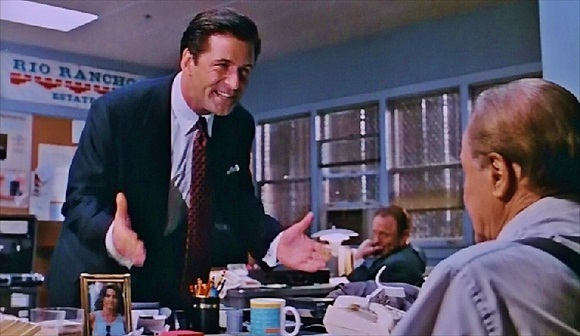
Glengarry Glen Ross (1992)
If you listen to the way people tell stories, you will hear that they tell them cinematically. They jump from one thing to the next, and the story is moved along by the juxtaposition of images—which is to say, by the cut.
   People say, "I'm standing on the corner. It's a foggy day. A bunch of people are running around crazy. Might have been the full moon. All of a sudden, a car comes up and the guy next to me says..."
   If you think about it, that's a shot list: (1) a guy standing on the corner; (2) shot of fog; (3) a full moon shining above; (4) a man says, "I think people get whacky this time of year"; (5) a car approaching.
   This is good filmmaking, to juxtapose images. Now you're following the story. What, you wonder, is going to happen next.
State and Main (2000)
The work of the director is the work of constructing the shot list from the script. The work on the set is nothing. All you have to do on the set is stay awake, follow your plans, help the actors be simple, and keep your sense of humor. The film is directed in the making of the shot list. The work on the set is simply to record what has been chosen to be recorded. It is the plan that makes the movie.

We can identify with the pursuit of a goal. It's much easier to identify with that than with "character traits."
Wag the Dog (1997)
Always do things the least interesting way, and you will make a better movie. This is my experience. Always do things the least interesting way, the most blunt way. Because then you will not stand the risk of falling afoul of the objective in the scene by being interesting, which will always bore the audience, who are collectively much smarter than you and me and have already gotten up to the punch line. How do we keep their attention? Certainly not by giving them more information but, on the contrary, by withholding information—by withholding all information except that information the absence of which would make the progress of the story incomprehensible.
Heist (2001)
You tell the story. Don't let the protagonist tell the story. You tell the story; you direct it. We don't have to follow the protagonist around. We don't have to establish his "character." We don't need to have anybody's "back story."
If you are telling a story, then the human mind, as it's working along with you, is perceiving your thrust, both consciously and, more importantly, subconsciously. The audience members are going to go along with that story and will require neither inducement, in the form of visual extravagance, nor explanation, in the form of narration.
   They want to see what's happening next. Is the guy going to get killed? Is the girl going to kiss him? Will they find the money buried in the old gold mine?
   When the film is correctly designed, the subconscious and conscious are in alignment, and we need to hear what happens next. The audience is ordering the events just as the author did, so we are in touch with both his conscious and his unconscious mind. We have become involved in the story.
On Directing Film is practical, provocative, cheap to buy, easy to read. Don't miss it.

Friday, 27 April 2012

Interview with Billy Marshall Stoneking

Billy Marshall Stoneking is an Australian screenwriter, poet and teacher who, though now based in Sydney, was born in the USA. He migrated to Australia in 1972, where he wrote the TV series Stringer and an episode of the show Mission: Impossible. 
   Billy will be teaching a one-day seminar in Adelaide on May 20, followed by a four-day seminar. I met him online and took the opportunity of asking some questions.
________________________________________________________________________

*  You didn’t go to film school, though you taught at the Australian Film Television and Radio School (AFTRS) for a number of years. How would you respond to David Mamet’s suspicion that film schools are “useless”?
I did attend the film school—AFTRS—1983 graduate, and I agree with David Mamet. Most film schools I know of, and I have been associated with a few of the ones in Sydney, are run by people who don’t really understand story or drama and have, overall, very little talent in the art of teaching. Schools tend to place more importance on buildings and equipment and technique than they do on discovery, risk and inspiration. 
   I am reminded of Whitehead’s comment: “The secondhandness of the learned world is the secret of its mediocrity." 
   Film schools simply don’t give their students enough opportunities to enter the drama. Drama is a language for presenting emotional energy and if you’re to become fluent in the language you have to use it, all the time. If a scene is the equivalent of a sentence and the language is drama, how can you possibly learn it making only ten or fifteen or thirty scenes a year. If you compared that to learning Spanish you’d have a very hard time getting yourself around Mexico City—let alone a compelling screenplay. Film schools, at best, teach little more than “tourist drama”.

*  What are three things you wish someone had told you about screenwriting when you were starting out?
It’s what I wish they hadn’t told me, but I’ll take a stab at it:
1) "No" always means "maybe"; 
2) Knowledge has nothing to do with it; and 
3) Never go to bed with anyone that has more problems than you do.

*  You famously wrote an episode of the TV series Mission: Impossible. How did that come about?
Impeccable connections—plus the producer wanted to option my best-selling book, Lasseter: In Quest of Gold.

*  That episode of Mission: Impossible was directed by Brian Trenchard-Smith, one of the most influential of all Australian directors. Did you work closely with him, and if so, what did you learn from the experience?
I know Brian from the old days, but I didn’t confer with him about his job. The script was fairly self-explanatory—as most of them were.

Tutama Tjapangarti
*  Who was the person who has had the biggest influence on you as a screenwriter? 
Tutama Tjapangarti would be up there with the best of them, though he never wrote a screenplay, or anything else for that matter—but wow—what a storyteller! 
   Others would have to include John Cassavetes, Ingmar Bergman, James Agee, and Woody Allen.

*  You are a script consultant with Script Central, which has been in business since 2003.  Can you give us one example of a script which passed through that agency and eventually become a decent Australian movie? 
Not offhand.

Maya Newell
*  Who would you consider the most interesting filmmaker currently working in Australia, and why? 
Maya Newell—she’s fresh, she’s smart, and she’s a very close friend.

*  How would you respond to the proposition that, these days, it is easier to make money teaching screenwriting than it is practicing screenwriting? 
Anyone who thinks teaching is easy has taken leave of their senses.

*  What has been the most memorable moment in your career to date? 
Every moment. I don’t think of it as a career.

*  What one book would you recommend to a young wannabe screenwriter in Adelaide? 
Audition by Michael Shurleff—don’t touch any of the others.

*  What are your ten favourite movies of all time? 
[ Billy provided a list of almost 200 movies. I really did want just ten, so have selected a representative sample from the longer list; which will probably offend him, but I'm sure we'll get over that. Life's too short, etc. You can see his full and evolving list here. ]
Network (1976)
Seven Samurai (1954)
*  You’re teaching a one-day seminar in Adelaide on 20 May 2012 called ‘Secrets, Lies and Filmmaking,’ followed by a four-day seminar called ‘The Drama of Screenwriting.’ What would you say to a young wannabe screenwriter to convince them to take time off work, and part with a handful of cash, in order to attend either of these events? 
They wont be taking time off work, they’ll be taking time off their job—there’s a difference. What they’ll do in the four-day workshop is work creatively in ways that they have never before experienced. It’s very much a learner-centred workshop— no sage on the stage—and its very collaborative. 
   What participant/writers go away with is an entirely new and useable way of looking at themselves and their characters and the stories they want to tell. Ditto for the one-day, but because it is only one day it is even more intense!
______________________________________________________________________

Thursday, 26 April 2012

"Thijs and the ladies"

How many actors do you need to make a short film? How about one actor, armed with a mirror?

Here's the first episode of a Dutch web series that featured at the 2011 Marseille Web Fest. The story line focuses on a hapless individual who is on the hunt for a girlfriend. 

The film has English subtitles, but you could probably follow it without their help. 


Wednesday, 25 April 2012

Overcoming your fears

Public ridicule. Pigeons. Heights. Asking a girl out. Pigeons. They're all common fears people suffer from. Especially pigeons.

If you ever wondered how to overcome your fears, meet a bloke who managed to defeat most of his.

Written and directed by Ross Johnston, somewhere in Belfast. Shot and edited by Neal Megaw. Naturally they didn't mention the names of the actors in this short film; they were concentrating on the pigeons.

    Vimio    YouTube