Showing posts with label The Actors. Show all posts

Wednesday, 13 May 2015

Michael Caine, "Acting in Film" and "Harry Brown"

I've been having a bit of a Michael Caine time lately. The guy's amazing. He's made over 150 movies, and is still going strong.

First I read his book, Acting in Film: An Actor's Take on Movie Making. This is a riveting, compelling read. He talks about acting, but much of what he says can be applied to screenwriting. 
There was no place allowed for the likes of me in the firmament of actors. Almost anybody has it made today compared to my chances thirty-five years ago.
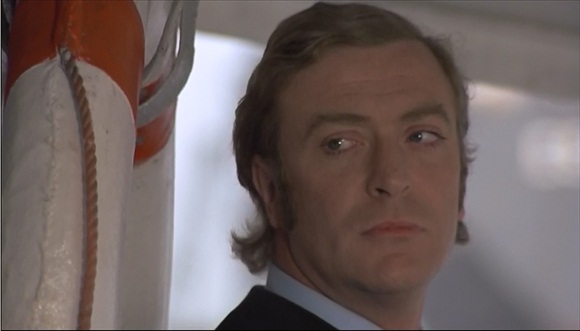
Flawless (2007)

Let me run through my curriculum vitae before I landed my first role.  See what you think of my chances. I had worked in a laundry. I'd done a stint in a tea warehouse. I'd worked pneumatic drills on the road. I was the night porter in a hotel. I washed dishes in all the best restaurants. I remember making jewel boxes at one time. And I was a soldier.
Get Carter (1971)

It's very difficult for people to comprehend that when I say I was broke at the age of twenty-nine, that I literally didn't have the price of a bowl of spaghetti down at the local diner. They think being broke is being down to your last couple of grand in the bank. My bank was in my pocket, and my account was full of lint.
The Quiet American (2002)
Chances are, you've had some formal higher education. Well, to me and my parents, going to grammar school was higher education. I had no classes to go to, or instructional videos to watch. But I was a tremendous reader of books. And from the pages of those books I discovered what other people's lives were like. They weren't like mine. And I became determined to change my life. I wasn't exploring the possibility, I was determined.
The Actors (2003)


If you really want to become an actor, but only providing that acting doesn't interfere with your golf game, your political ambitions, and your sex life, you don't really want to become an actor. Not only is acting more than a part-time job, it's more than a full-time job. It's a full-time obsession. Anything less and you'll fall short of the mark.
It's a great book, full of the wisdom of the years. You won't be disappointed. 

Harry Brown (2009)
Next I watched him in Harry Brown (2009). It's a simple story, told in an uncomplicated linear fashion, but with immense power. Great script, great acting, great direction. And one of the few films which distinguished itself in my experience by the way it employs both sound and silence. There's much a screenwriter could take from the film. Recommended viewing. 

Harry Brown reminded me of one of Michael Caine's early films, Get Carter (1971). In the first he's the lone avenger of a murdered best friend, in the second he's the lone avenger of a murdered brother.

Get Carter (1971)
One of the interesting scenes in Get Carter takes place in a pub early in the movie. Caine arrives and orders a beer "in a thin glass." Further along the bar we're shown a man taking a drink, and, if you're paying attention, you'll see a hand with six fingers (okay, five fingers, and a thumb). Go on, count them. This isn't CGI or film trickery, it's real. A little joke Michael Caine enjoyed, particularly as almost no one watching the movie ever notices.

The Princess Bride (1987)

The "six-fingered man" made a notable reappearance in The Princess Bride (1987), some sixteen years later.

Michael Caine has made at least six movies since Harry Brown, so I still have some catching up to do. 
  
First posted:  20 October 2011
 

Saturday, 29 October 2011

Three-act structure?

It was laid out for the general public in Syd Field's book Screenplay and, like most aspiring screenwriters, I ran into three-act theory early on.

To be honest, I couldn't see it at all. 

I read Linda Seger's book, Making a Good Script Great, which repeats Field's demand that a screenplay consist of 120 pages, divided into thirty pages of act 1, sixty pages of act 2, and thirty pages of act 3. 

Then she talked about a Midpoint, which divides act 2 into 2A and 2B. I thought, "Doesn't that make for a four-act structure?"  But things got worse, because the Midpoint scene can be stretched out into a sequence or, dare I say it, an Act in its own right, giving us a five act structure.

Oh, and by the way, don't most of Shakespeare's plays consist of five acts? 

An opening frame from the Irish movie, The Actors.
Some movies publish the fact that they were designed as a five-act play. One such is the Michael Caine movie, The Actors (2006). [Good movie, a personal favourite. Check it out.] The fact is explicitly stated on a screen which says, A Film In Five Acts... Then each act is introduced with its own title card.

Click on this page
In the old days, movies were written with an explicit five-act structure. You don't need to be some kind of genius to know that; it was shown clearly on the page. If you look at the scripts of some of the great movies from the 1940s and '50s, such as Double Indemnity (1944) or Sunset Blvd. (1950), you will see that the scenes aren't numbered 1, 2, 3, etc., but rather A-1, A-2, A-3, and so on. A=Act 1. The scenes in Act 2 are numbered B-1, B-2, B-3, etc. And on and on up to scenes numbered E-1, E-2, E-3, etc.

'A' to 'E', that's FIVE acts. (I've included a page sample from Double Indemnity to the right,)

To this day, both Final Draft and Movie Magic Screenwriter have the capacity to label scenes with that same alpha-numeric designation. 

In addition to these complications, there are also the made-for-television movies, known as "Movie Of the Week" (MOW) in the US. They consist of seven acts (the commercial breaks are written into the screenplay). 

The bulk of the gurus tramping the I'll-teach-you-how-to-to-write-a-hit-movie circuit (who have, themselves, never written a hit movie) talk about three-act structure. Occasionally you will come across a commentator who tells a different story. One such is John Truby. In his book, The Anatomy of Story: 22 Steps to Becoming a Master Storyteller, he says: 
"... three act structure, albeit a lot easier to understand than Aristotle, is hopelessly simplistic and in many ways just plain wrong. ... Three-act structure is a mechanical device superimposed on the story and has nothing to do with its internal logicwhere the story should or should not go."
Another is William Froug. Read his book Screenwriting Tricks of the Trade. He says:
It is not valuable to recommend that new screenwriters write by the numbers.
He goes on to tell the following story.
I attended a seminar of "Film and Literature" at Key West this past winter. One of the panelists remarked, surprisingly, that all movie stories are told in three acts, to which fellow-panelist screenwriter William Goldman replied, "Really? I didn't know that." I began to think of three of Goldman's best screenplays: Marathon Man (based on his novel), A Bridge Too Far, and Butch Cassidy and the Sundance Kid. None of them follow the conventional three act structure.
William Froug adds a quote from Daniel Pyne, writer of numerous TV shows and feature films:
I completely eschew the formula of first, second, and third acts. I've run into too many writers who get lost in that old formula. They know where the first act ends, and they know where the second act ends, but their entire script is treading water because they're just writing from point to point.
Howard Suber well said: With regard to any specific movie, everyone will agree on where the first act begins and where the third act ends, but there is often no agreement about where the second act begins and endseven among the people who make the film.

In his book Hollywood Animal, Joe Eszterhas explains how he wrote the movie Basic Instinct
I had written ... movies where men manipulated the women who loved them. I thought it would be fun to flip the dynamic: to do a movie about a man being manipulated by a woman who is brilliant, omnisexual and evil. ... The piece wrote itself. I improvised all the way through. I made no notes for myself, no outline. I simply put the things down which the characters said to me. Three weeks from the time I started thinking about it, I finished the piece.
Basic Instinct is not structured with three acts. Instead it is a narrative punctuated by reference to books: the one Catherine wrote describing the murder; the one she wrote about the boy killing his parents "to see if he could get away with it"; the one she is writing, which when finished results in her telling Nick it's all over; and the one Nick says he's writing, with its impossibly happy ending, which will guarantee his eventual demise at Catherine's hands.

There are those who claim that a film must have a three-act structure, and they often claim that Aristotle gave this "rule" to us. In fact, there were no acts as we define the term today in Greek drama, and Aristotle did not talk about acts at all because the plays he analyzed were all presented in a single continuous performance.
The three-act structure that so many people ascribe to Aristotle was, in fact, invented more than two thousand years later when Ibsen and other nineteenth-century dramatists found that their audiencesunlike the drama groupies of Periclean Athens—were unable to sit still for the entire duration of a full-length play.
A movie has to start somewhere, go somewhere, and eventually finish. As Jean-Luc Goddard famously said, A film should have a beginning, a middle and an end. But not necessarily in that order. Structure is necessary and good, but beware of approaching it from a fixed POV. 

Jokes have structure, but only one rule: the punchline comes last. The rest can be told in whatever order suits you, but once the punchline appears anywhere but at the end, it stops being a joke and becomes something else. One of the best illustrations of this fact is the documentary The Aristocrats (2005), which consists of a hundred comedians telling just one joke. They tell it in a hundred different ways, but the punchline stays the same, and it always comes at the end. (I have to warn you it should be R-rated for the language.) 

I think every wannabe screenwriter should study the various theories of structure until they understand them, then they should set it all aside and focus on writing their story the best way they can. The problem with embracing three-act structure as an article of faith is that you end up being able to see only what you expect to see, rather than what's actually there, and you may find yourself artificially imposing a structure on your story that won't do it justice.

Thursday, 20 October 2011

Michael Caine, "Acting in Film" and "Harry Brown"

I've been having a bit of a Michael Caine time lately. The guy's amazing. He's made over 150 movies, and is still going strong.  

First I read his book, Acting in Film: An Actor's Take on Movie Making. This is a riveting, compelling read. He talks about acting, but much of what he says can be applied to screenwriting. 
There was no place allowed for the likes of me in the firmament of actors. Almost anybody has it made today compared to my chances thirty-five years ago.
Flawless (2007)

Let me run through my curriculum vitae before I landed my first role.  See what you think of my chances. I had worked in a laundry. I'd done a stint in a tea warehouse. I'd worked pneumatic drills on the road. I was the night porter in a hotel. I washed dishes in all the best restaurants. I remember making jewel boxes at one time. And I was a soldier.
Get Carter (1971)

It's very difficult for people to comprehend that when I say I was broke at the age of twenty-nine, that I literally didn't have the price of a bowl of spaghetti down at the local diner. They think being broke is being down to your last couple of grand in the bank. My bank was in my pocket, and my account was full of lint.
The Quiet American (2002)
Chances are, you've had some formal higher education. Well, to me and my parents, going to grammar school was higher education. I had no classes to go to, or instructional videos to watch. But I was a tremendous reader of books. And from the pages of those books I discovered what other people's lives were like. They weren't like mine. And I became determined to change my life. I wasn't exploring the possibility, I was determined.
The Actors (2003)


If you really want to become an actor, but only providing that acting doesn't interfere with your golf game, your political ambitions, and your sex life, you don't really want to become an actor. Not only is acting more than a part-time job, it's more than a full-time job. It's a full-time obsession. Anything less and you'll fall short of the mark.
It's a great book, full of the wisdom of the years. You won't be disappointed. 

Harry Brown (2009)
Next I watched him in Harry Brown (2009). It's a simple story, told in an uncomplicated linear fashion, but with immense power. Great script, great acting, great direction. And one of the few films which distinguished itself in my experience by the way it employs both sound and silence. There's much a screenwriter could take from the film. Recommended viewing. 

Harry Brown reminded me of one of Michael Caine's early films, Get Carter (1971). In the first he's the lone avenger of a murdered best friend, in the second he's the lone avenger of a murdered brother.

Get Carter (1971)
One of the interesting scenes in Get Carter takes place in a pub early in the movie. Caine arrives and orders a beer "in a thin glass." Further along the bar we're shown a man taking a drink, and, if you're paying attention, you'll see a hand with six fingers (okay, five fingers, and a thumb). Go on, count them. This isn't CGI or film trickery, it's real. A little joke Michael Caine enjoyed, particularly as almost no one watching the movie ever notices.

The Princess Bride (1987)

The "six-fingered man" made a notable reappearance in The Princess Bride (1987), some sixteen years later.

Michael Caine has made at least six movies since Harry Brown, so I still have some catching up to do.