"The theatre is an operation with the scalpel, I think movie acting is an operation with the laser."
First posted: 14 June 2014

Adelaide Screenwriter : Screenwriting, Movies, Tuckshop & Charm School.
"The theatre is an operation with the scalpel, I think movie acting is an operation with the laser."

 Writers tend to worry about dialogue, with good reason. A bad line can kill a scene. A good line can become the buzz phrase of the year. And be quoted in the actor's biography, with all credit to them, but that's the business we've chosen.
 |
| Hannah and Her Sisters |
You can bring new life to an apparently mundane reply by planning a thought process based on a key word and then never voicing it.
Other actor: "Would you like some tea?"
You: "Yes, please."
"Tea" is the key word. The simple word "tea" can open up so many responses. Let's say you would have preferred coffee. The minute the other actor says "tea," your eyes will change because you'd really like coffee. Or maybe you're allergic to tea. Then you answer politely, but with a bit of anguish, knowing that you won't really drink it. The camera thrives on niceties like that; yet you often see actors missing out on these little presents that can open whole realms of possible action.
"Tea" could be an indication that he's too poor to offer you booze, or that he regards you as an alcoholic who shouldn't be offered a drink. Take the script and explore these possibilities because to pick up key words opens a repertoire of potential response that can lift a scene off the page and into reality. Don't make a fetish of it or you will complicate things unnecessarily. You'll seem a maniac if everything sets you off. But take it to reasonable bounds and you'll find that your performance is more interesting to you and more believable on the screen.
 |
| Dirty Rotten Scoundrels |
When I was very young and in repertory theatre, I was given some advice by a clever director. He said:
"What are you doing in that scene, Michael?"
"Nothing," I said, "I haven't got anything to say."
"That," said the director, "is a very big mistake. Of course, you have something to say. You've got wonderful things to say. But you sit there and listen, thinking of wonderful things to say, and then you decide not to say them. That's what you're doing in that scene."
And that's the greatest advice I can give to someone who wants to act in movies. Listen and react. If you're thinking about your lines, you're not listening.
 |
| David Niven listening to Claudia Cardinale in The Pink Panther |
 I first encountered that advice, second-hand, from another great English actor. David Niven published his first autobiography, The Moon's a Balloon, in 1971. In it he provides an endless stream of anecdotes from the Golden Age of Hollywood, including the following:
Irving and Norma, like all top movie people, had a private projection room in their house. One night Lubitsch brought down a print of Bluebeard's Eighth Wife and they ran it after dinner for their friends.
I sat squirming with embarrassment throughout the showing but after it was over, everyone, with one exception, was overly flattering and enthusiastic. Fairbanks and Sylvia, Merle, the Astaires, Paulette Goddard and Frederick Lonsdale, all puffed me up most pleasantly. One guest sat silent in his chair. Finally, I could stand it no longer.
"What did you think, Mr. Chaplin?"
His answer constituted the greatest advice to any beginner in my profession.
"Don't be like the majority of actors... don't just stand around waiting your turn to speak—learn to listen."

Movie scripts are not Holy Writ. As if to prove its fallibility, the director (Sidney Furie), on the first day on the set of The Ipcress File
, put the script on the floor, set fire to it, and said, "That's what I think of that." We all stood there looking at each other. I was a bit baffled. "What are we going to shoot?" I said. In the end, the director used my copy. But I was allowed to improvise a lot.
 |
| Michael Caine and Maggie Smith in California Suite |
California Suite I did a picture called California Suite, which was written by the great American comedy writer Neil Simon. He visited the set the first day, came over to Maggie Smith and me and said, "Listen, if you think of anything funny, you know, ad libs, put 'em in. But tell me what they are first. And they better be funnier than what I've written." We thought and we thought. Our poetic license hung heavy on our conscience. And needless to say, we never ad-libbed a word.
There was no place allowed for the likes of me in the firmament of actors. Almost anybody has it made today compared to my chances thirty-five years ago.
 |
| Flawless (2007) |
Let me run through my curriculum vitae before I landed my first role. See what you think of my chances. I had worked in a laundry. I'd done a stint in a tea warehouse. I'd worked pneumatic drills on the road. I was the night porter in a hotel. I washed dishes in all the best restaurants. I remember making jewel boxes at one time. And I was a soldier.
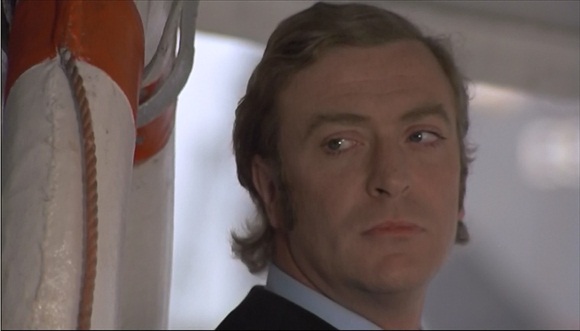 |
| Get Carter (1971) |
It's very difficult for people to comprehend that when I say I was broke at the age of twenty-nine, that I literally didn't have the price of a bowl of spaghetti down at the local diner. They think being broke is being down to your last couple of grand in the bank. My bank was in my pocket, and my account was full of lint.
 |
| The Quiet American (2002) |
Chances are, you've had some formal higher education. Well, to me and my parents, going to grammar school was higher education. I had no classes to go to, or instructional videos to watch. But I was a tremendous reader of books. And from the pages of those books I discovered what other people's lives were like. They weren't like mine. And I became determined to change my life. I wasn't exploring the possibility, I was determined.
 |
| The Actors (2003) |
It's a great book, full of the wisdom of the years. You won't be disappointed.If you really want to become an actor, but only providing that acting doesn't interfere with your golf game, your political ambitions, and your sex life, you don't really want to become an actor. Not only is acting more than a part-time job, it's more than a full-time job. It's a full-time obsession. Anything less and you'll fall short of the mark.
 |
| Harry Brown (2009) |
 Next I watched him in Harry Brown
 (2009). It's a simple story, told in an uncomplicated linear fashion, but with immense power. Great script, great acting, great direction. And one of the few films which distinguished itself in my experience by the way it employs both sound and silence. There's much a screenwriter could take from the film. Recommended viewing. reminded me of one of Michael Caine's early films, Get Carter
 (1971). In the first he's the lone avenger of a murdered best friend, in the second he's the lone avenger of a murdered brother.
 |
| Get Carter (1971) |
 |
| The Princess Bride (1987) |
 (1987), some sixteen years later.
"The theatre is an operation with the scalpel, I think movie acting is an operation with the laser."
Writers tend to worry about dialogue, with good reason. A bad line can kill a scene. A good line can become the buzz phrase of the year. And be quoted in the actor's biography, with all credit to them, but that's the business we've chosen. |
| Hannah and Her Sisters |
You can bring new life to an apparently mundane reply by planning a thought process based on a key word and then never voicing it.
Other actor: "Would you like some tea?"
You: "Yes, please."
"Tea" is the key word. The simple word "tea" can open up so many responses. Let's say you would have preferred coffee. The minute the other actor says "tea," your eyes will change because you'd really like coffee. Or maybe you're allergic to tea. Then you answer politely, but with a bit of anguish, knowing that you won't really drink it. The camera thrives on niceties like that; yet you often see actors missing out on these little presents that can open whole realms of possible action.
"Tea" could be an indication that he's too poor to offer you booze, or that he regards you as an alcoholic who shouldn't be offered a drink. Take the script and explore these possibilities because to pick up key words opens a repertoire of potential response that can lift a scene off the page and into reality. Don't make a fetish of it or you will complicate things unnecessarily. You'll seem a maniac if everything sets you off. But take it to reasonable bounds and you'll find that your performance is more interesting to you and more believable on the screen.
|
| Dirty Rotten Scoundrels |
When I was very young and in repertory theatre, I was given some advice by a clever director. He said:
"What are you doing in that scene, Michael?"
"Nothing," I said, "I haven't got anything to say."
"That," said the director, "is a very big mistake. Of course, you have something to say. You've got wonderful things to say. But you sit there and listen, thinking of wonderful things to say, and then you decide not to say them. That's what you're doing in that scene."
And that's the greatest advice I can give to someone who wants to act in movies. Listen and react. If you're thinking about your lines, you're not listening.
|
| David Niven listening to Claudia Cardinale in The Pink Panther |
I first encountered that advice, second-hand, from another great English actor. David Niven published his first autobiography, The Moon's a Balloon, in 1971. In it he provides an endless stream of anecdotes from the Golden Age of Hollywood, including the following:Irving and Norma, like all top movie people, had a private projection room in their house. One night Lubitsch brought down a print of Bluebeard's Eighth Wife and they ran it after dinner for their friends.
I sat squirming with embarrassment throughout the showing but after it was over, everyone, with one exception, was overly flattering and enthusiastic. Fairbanks and Sylvia, Merle, the Astaires, Paulette Goddard and Frederick Lonsdale, all puffed me up most pleasantly. One guest sat silent in his chair. Finally, I could stand it no longer.
"What did you think, Mr. Chaplin?"
His answer constituted the greatest advice to any beginner in my profession.
"Don't be like the majority of actors... don't just stand around waiting your turn to speak—learn to listen."
It's amazing how poorly writers are regarded by some of the people who make their living off the back of writers' work. Here's an anecdote from Michael Caine's book, Acting in Film.Movie scripts are not Holy Writ. As if to prove its fallibility, the director (Sidney Furie), on the first day on the set of The Ipcress File
|
| Michael Caine and Maggie Smith in California Suite |
California Suite I did a picture called California Suite

 , Michael Caine says this about acting:
When becoming a character, you have to steal. Steal whatever you see. You can even steal from other actors' characterizations; but if you do, only steal from the best. If you see Vivian Leigh do something, or Marlon Brando, or Robert de Niro or Meryl Streep do something that fits your character, steal it. Because what you're seeing them do, they stole.
 |
| Austin Kleon |
Here's what artists understand. It's a three-word sentence that fills me with hope every time I read it. Nothing is original. It says it right there in the Bible. Ecclesiastes: That which has been is what will be, That which is done is what will be done, And there is nothing new under the sun.

 , William Froug says this:
It doesn't matter one bit how often your story has been told before; you must retell it better, with a fresh and different approach. When you tell an old story in a new way, it becomes a new story.

When Travis Beacham (Clash of the Titans, Pacific Rim) was just an aspiring writer, he ... said to me “there’s no such thing as an original story – to approach writing a new script thinking you’re going to write a story that’s unique and original and No One Else Has Ever Seen is a fool’s errand. Man has been writing for thousands of years – every story that will ever be told has been done.”
I (sent) out his script The Gloaming to my contacts in order to try to help him sell it. The script was getting immediate and overwhelmingly positive reaction, and people were calling it “creative,” “inventive,” “amazing,” etc. it looked like he was going to get a great manager, agent, and soon – a sale. After a couple months, it had a new title courtesy of Arnold Kopelson (Killing on Carnival Row) and was sold to New Line Cinema.
Now, this script was a steampunk fantasy about a city with fairies, werewolves, etc., and a human detective who is trying to find and catch a serial killer who is terrorizing the Fairy Quarter. It was a startling, exciting, unique storyworld, and instantly captured people’s attention. People were falling over themselves to call it “fresh” and “original,” but here’s the thing – the story is basically The Fugitive. Travis took the story and structure of The Fugitive, and put it in a freaky, cool, interesting, unique world with suitably unique matching dialogue and characters.
He was hailed as original, not because he was reinventing the wheel when it came to story, but because he took a simple story, and gave it interesting, complex, unique layers.
A good poet will usually borrow from authors remote in time, or alien in language, or diverse in interest. — T.S.Eliot
Every idea is a juxtaposition. That’s it. A juxtaposition of existing concepts. — Steven Grant
If you steal from one author, it’s plagiarism; if you steal from many, it’s research. — Wilson Mizner
All writing is in fact cut-ups. A collage of words read heard overheard. What else? — William S. Burroughs
It’s not where you take things from—it’s where you take them to. — Jean-Luc Godard
Plagiarism is basic to all culture. — Pete Seeger
Bad artists copy, good artists steal. — Pablo Picasso
Books serve to show a man that those original thoughts of his aren’t very new at all. — Abraham Lincoln
So what are you waiting for? Go on, steal... like an artist.Those who do not want to imitate anything, produce nothing. — Salvador Dali


